DISCLAIMER: This content was published in 2021 and is NOT being updated.
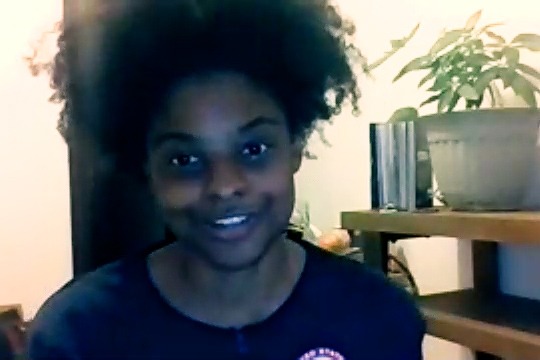
Despite playing a multitude of sports in her childhood, Nzingha Prescod quickly embraced the physical and mental challenge of fencing after being introduced to the sport at age 9 through the Peter Westbrook Foundation. Her passion to continue improving and mastering the sport led her to earn her first senior world medal at the age of 15. In just four more years, Prescod reached the pinnacle of her sport by qualifying for the 2012 London Olympic Games, where her team placed sixth. Around this time, she also competed at the 2011 Pan American Games, where her team won gold and she won silver, and at the 2015 Pan American Games, where her team won silver. Her success earned her another spot on Team USA for the 2016 Rio Olympic Games. After the Games, Prescod’s team won the 2018 Team World Championship. Spanning her career, she won five world championship titles across Cadet, Junior, and Senior categories.
Now retired, Prescod has committed to preserving the integrity and value of sport by becoming an Anti-Doping Education Athlete Presenter with USADA. She will draw on her long-time experience as an athlete subject to anti-doping rules to both explain the rules themselves and the importance of those rules to today’s athletes.
Video Transcript
I started fencing when I was 9 years old at the Peter Westbrook Foundation, and my mom put me in fencing. She put me in a lot of sports, so I did tennis, gymnastics, swimming, t-ball, and ballet since I was like 3, and then I just kept fencing.
It was just fun for me, and I always just wanted to be better at it. I just wanted—I like the challenge; it’s a lot of like thinking and problem solving.
My Peter Westbrook family, like, the focus is so much on the community, not on winning. So that kind of like takes it—it just wouldn’t make sense, because we’re all there to become our best selves and push ourselves, and it just—it doesn’t serve that purpose to cheat. But I would say my fencing family, it’s really not even a part of the discussion; it’s clear no one’s even encouraging that kind. There’s no temptation to dope, and I think it’s all about who you surround yourself with. Like, I think in fencing in the U.S., that’s not super concentrated in the conversation, but when we bring it more globally, I think it becomes more relevant.
But I think it’s all who you surround yourself with, and how the system you operate in, what the expectations are of you. And so I grew up in a system where that wasn’t eve considered, and it’s obviously not the right choice.
I think the core principle of anti-doping is fairness, and I think if we apply that to anywhere in life and society, I think you’ll uplift humanity and society.
So, I think just the inherent nature of USADA and clean sport is to uphold the standard that everyone compete clean, for everyone to have a fair shot, have the same opportunity for success in an equitable way. And if sport is kind of devalued because the players in it are doing something illegal and you’re messing with the integrity of sport, the value of sport and how highly it’s revered in the world becomes compromised potentially.
So I think it’s really important to preserve that for everyone, because I think when there’s a couple like rotten apples, it has potential to ruin this gift that we all have. I think one of the really cool things as an athlete who’s gone through it, when you first start the process, like when you first start getting drug-tested, you’re kind of confused about what the purpose is, or like, why are they coming to my home? I think it can be a disturbance sometimes, but I think understanding that it’s necessary to maintain the integrity of sport and to make sure that everyone is competing fair.
It doesn’t shine a great light when there’s all these reports of doping, and I want to preserve- I want everyone to see my sport and Olympics the way that I see it, and as a vehicle for development, personal character development, and like for opportunities to progress your life.
Joining clean sport was awesome because I think it helps preserve the value of sport, and I think it’s, yeah, like I said, sport is so special, so anything I can do to preserve it and make sure it’s kept intact for for the next generation is really important.