
Team USA Athletes Ombuds
A safe place to seek confidential, independent, impartial advice and assistance on sport-related matters.
The Team USA Athlete Ombuds serves as a safe, independent, and confidential place for Team USA athletes to seek advice about:
- any sport-related rule, policy, or process;
- how to navigate raising or responding to concerns;
- how to access to legal and mental health resources.
Team USA athletes navigating anti-doping rules, policies or processes may reach out to the Athlete Ombuds (ombudsman@usathlete.org). All other athletes (e.g., junior, masters, recreational, non-Olympic or Paralympic disciplines) may wish to visit usathlete.org to learn about anti-doping, legal, and mental health resources.
TEAM USA
Athlete Mental Health Resource Guide
The United States Olympic & Paralympic Committee offers a variety of resources for athlete mental health and support. Click the image or the button below to view the full resource guide that includes details on insurance, help lines, and mental wellness applications.
If you need urgent support, please call the Team USA Mental Health Support line at (719) 866-CALL (2255).
Frequently Asked Questions
Got Questions?
Click on the question to drop down the answer.
How is an athlete informed of an Adverse Analytical Finding or other potential anti-doping rule violation?
After receiving notification from the laboratory of an Adverse Analytical Finding (AAF), or if USADA has decided to move forward with a non-analytical case (proof of a violation based upon evidence other than an AAF), USADA will notify the athlete, the USOPC, the relevant IF, WADA, and the athlete’s NGB. When the athlete’s ”A”’ sample has returned a positive result, the athlete will have the opportunity to request that their “B” sample be tested and be present at the laboratory for the ”B” sample opening.
How long after an Adverse Analytical Finding report by the laboratory does the "B" sample opening and analysis occur?
The “B” sample opening and analysis typically occurs within 10 working days after the athlete’s request that their “B” sample be analyzed.
What happens if the "B" sample analysis confirms the Adverse Analytical Finding?
This is considered a positive test and USADA will charge the athlete with an anti-doping rule violation.
Does the athlete have the right to a hearing if USADA proceeds with adjudication as a result of a positive test, or other potential rule violation?
Yes. The athlete has the right to contest the sanction sought by USADA by electing to proceed to a hearing before the independent arbitral body designated to resolve alleged rule violations.
What rules apply to the hearing process?
The standard commercial arbitration rules of the independent arbitral body, as modified by USADA’s Procedures for the Arbitration of Olympic & Paralympic Sport Disputes, apply to the hearing process.
How long does the hearing process take?
The hearing will be completed within two months of the appointment of the arbitrator, except in cases involving extraordinary circumstances, upon good cause shown by a party, in cases of sufficient complexity where completion within two months is not reasonable, or if the parties mutually agree on a different schedule.
What rules apply to sanctions for anti-doping rule violations?
Under the USADA adjudication process, sanctions for anti-doping rule violations must be consistent with the World Anti-Doping Code, the relevant IF rules, or the USOPC National Anti-Doping Policies.
Who pays for the adjudication process?
USADA pays all administrative costs relating to the testing and results management of the athlete’s sample. The athlete pays for all of their defense, including travel, legal fees, and expert witness costs. The parties’ responsibility for the costs of the arbitration process are set forth in Rules 25(c) and 45-48 of USADA’s Procedures for the Arbitration of Anti-Doping Rule Violations.
Does the International Federation have a role in the adjudication process?
The IF receives notice of all steps in the process after a decision to move forward with a case has been made. The IF is invited to appear as a party or observer at the arbitration hearing and has the right to appeal the decision under the World Anti-Doping Code.
If the Adverse Analytical Finding arises from a test conducted by the IF, does USADA bring the case?
In many cases, if a test conducted by an IF on a U.S. athlete results in an Adverse Analytical Finding, the IF will forward the case to USADA to handle the results management process and adjudication.
Additional Resources
Clean Sport Handbook
New TUE Application Steps
Click on each step to open the details.
Accessing Critical Medication while Competing Clean
In some situations, an athlete may have an illness or condition that requires the use of medication listed on the World Anti-Doping Agency’s Prohibited List. USADA can grant a Therapeutic Use Exemption (TUE) in these situations in compliance with the World Anti-Doping Agency International Standard for TUEs. The TUE application process is thorough and designed to balance the need to provide athletes access to critical medication while protecting the rights of clean athletes to compete on a level playing field.
Step 1: Find your Condition
Please download all relevant documents for your specific medical condition (including both the USADA checklist and WADA guidelines). If your condition is not listed, please choose the “Other Conditions” option.
ADD/ADHD (Stimulants)
USADA Checklist
WADA Guidelines
Adrenal Insufficiency (Glucocorticoids, Mineralocorticoids, DHEA*)
USADA Checklist
WADA Guidelines
Anaphylaxis (Epinephrine, Glucocorticoids, B2 Agonists)
USADA Checklist
WADA Guidelines
Androgen Deficiency/Male Hypogonadism (Testosterone, hCG – Human Chorionic Gonadotropin)
USADA Checklist
WADA Guidelines
Asthma (B2 Agonists & Inhaled Glucocorticoids)
USADA Checklist
WADA Guidelines
Cardiovascular Conditions (Beta-blockers)
USADA Checklist
WADA Guidelines
Diabetes Mellitus (Insulin)
USADA Checklist
WADA Guidelines
Female & Male Infertility/PCOS (Aromatase Inhibitors, Clomiphene Citrate, hCG, Letrozole, Spironolactone)
USADA Checklist – FEMALE
USADA Checklist – PCOS
USADA Checklist – MALE
WADA Guidelines – PCOS
WADA Guidelines – Female Infertility
Growth Hormone Deficiency – Adult (recombinant human growth hormone – rhGH)
USADA Checklist
WADA Guidelines
Growth Hormone Deficiency – Child & Adolescent (recombinant human growth hormone – rhGH)
USADA Checklist
WADA Guidelines
Inflammatory Bowel Disease (Glucocorticoids)
USADA Checklist
WADA Guidelines
Intravenous Infusions (e.g. Normal Saline Solution – NSS, Lactated Ringer’s Solution – LRS, Dextrose in Water – D5W/D2.5W/D5LRS) in excess of 100mL/12hours and/or with a prohibited substance
USADA Checklist
WADA Guidelines
Intrinsic Sleep Disorders (Stimulants)
USADA Checklist
WADA Guidelines
Musculoskeletal Conditions (Glucocorticoids, Narcotics)
USADA Checklist
WADA Guidelines
Pain Management (Narcotics, Cannabinoids)
USADA Checklist
WADA Guidelines
Other Conditions
USADA Checklist
Renal Transplantation (Glucocorticoids, Beta-Blockers, Diuretics, Erythropoietin-EPO)
USADA Checklist
WADA Guidelines
Sinusitis/Rhinosinusitis (Glucocorticoids, Pseudoephedrine)
USADA Checklist
WADA Guidelines
For all WADA Guidelines, please click here.
Step 2: Download the TUE application
Click the link below to open the application in browser, and then download the PDF to fill out.
Step 3: Complete the TUE application and collect medical documents
Bring all forms and guidelines with you to your doctor’s visit.
Work with your physician to fill out the TUE application and collect supporting documents listed on the guidance document for your condition. Please ensure that your physician has correctly completed all medical information & diagnosis, medication details, and physician declaration sections in the TUE application.
Please note that any TUE application submitted to USADA without medical documentation will be returned to the athlete and will not be processed.
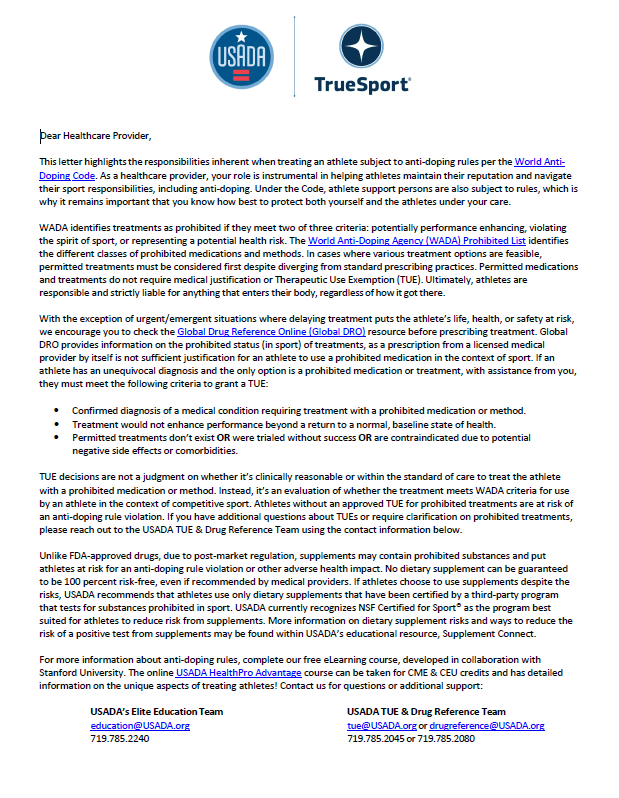
Click the image below to download a letter for athletes to take to their healthcare teams so they may better understand their anti-doping responsibilities.
Step 4: Review your TUE application
Please review your TUE application to ensure that it is complete and includes the proper medical documentation to support your medical diagnosis, and is organized in a logical fashion. All TUE applications must contain sufficient medical information, including clinic and laboratory testing notes, to allow the USADA TUE Committee make the same diagnosis and arrive at the same treatment plan as your physician without ever seeing you as a patient.
To ensure all components are included in the applications submission, we recommend athletes submit the TUE application and medical documents at the same time. We consider it best practice for athletes to keep a copy of the entire application packet for their records.
Step 5: Submit COMPLETED application to USADA
Submit your application to USADA by filling out the form below. For those sports with a sport specific international federation TUE, you may submit the application to USADA and we will handle getting the application information to your international federation.
Please note that any TUE application submitted to USADA without medical documentation will be returned to the athlete and will not be processed.
INCOMPLETE OR UNORGANIZED APPLICATIONS WILL BE RETURNED. Please save your files in a chronological organized fashion: LAST NAME, First name- “File Type” (Ex. SMITH, John- TUE Application)
**PLEASE NOTE THAT IT MAY TAKE 3-5 BUSINESS DAYS TO RECEIVE A RESPONSE.**