Every year, the World Anti-Doping Agency (WADA) publishes an updated Prohibited List. The 2027 WADA Prohibited List includes relatively minor changes, but we’ve detailed important updates that athletes and stakeholders should be aware of below. The updated list will go into effect on January 1, 2027.
As usual, the 2027 Prohibited List also includes new examples of prohibited substances and a few clarifications. It’s important to keep in mind that the WADA Prohibited List is not exhaustive and there could be substances that are not specifically listed but still belong to a category on the Prohibited List. Before taking medications, it is important to check GlobalDRO.com and search by brand name or ingredients for the most up to date anti-doping status information.
Under the World Anti-Doping Code, athletes are strictly liable, meaning they are ultimately responsible for what is in their systems. The 2027 Prohibited List and WADA’s explanatory note on the modifications can be found here.
S0. Non-Approved Substances
Many peptides, which are not approved for human use by regulatory authorities, fulfill the criteria in the World Anti-Doping Code for inclusion on the Prohibited List and fall under the S0 (Non-Approved Substances) class, or other classes (such as S2 or S4).
These peptides include, but are not limited to:
- BPC-157 (Prohibited under S0)
- TB-500 (Prohibited under S2)
- AOD-9604 (Prohibited under S2)
- hGH 176-191 (Prohibited under S2)
- GH-releasing peptides (GHRPs) (Prohibited under S2)
- CJC-1293, Thymosin-beta 4 (Prohibited under S2)
- Insulin-like growth factor 1 (IGF-1, mecasermin) and its analogues (Prohibited under S2)
- Ibutamoren (MK-677) (Prohibited under S1)
- Ipamorelin (Prohibited under S2)
- Insulin (Prohibited under S4)
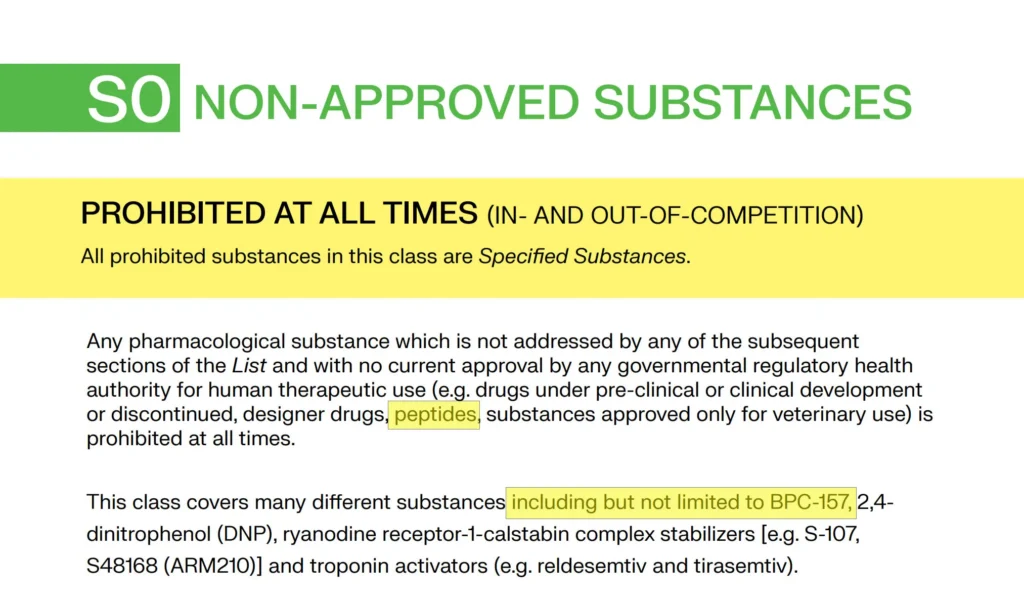
On the 2027 Prohibited List, “peptides” in general are now named as prohibited substances in the S0 class. Even if a peptide is not specifically named on the List, utmost caution should be taken, as it may still be prohibited and may be harmful to health.
There is a striking upward trend in the use of “peptides” for all kinds of purposes, including possibly doping. However, athletes need to be aware that the current “peptide craze” may pose serious anti-doping and health risks.
Athletes should also be aware that not all prohibited peptides are specifically listed on GlobalDRO.com. While Global DRO lists prohibited peptides as we become aware of them, there could be prohibited peptides sold under different names or slang terms. In addition, there could be experimental peptides that are not on the radar of the anti-doping community but are being sold online.
Even if a peptide is not named on Global DRO or the WADA Prohibited List, utmost caution should be taken, as it may still be prohibited and may be harmful to health. Athletes can read this article on peptide hormones for more information.
Additionally, S0 substances are prohibited at all times.
The S0 category is for:
- any pharmacological substance which doesn’t fall into one of the WADA categories and
- isn’t approved for human therapeutic use by any governmental health agency anywhere in the world.
This includes drugs under pre-clinical or clinical development or discontinued, designer drugs, peptides, or substances approved only for veterinary use.
S4. Hormone and Metabolic Modulators.
This category was updated by adding a few examples:
- Imlunestrant (brand name Inluriyo)
- Seladelpar (PPAR-delta agonist) (brand name Livdelzi)
- SLU-PP-332 and SLU-PP-915 (metabolic modulators acting on oxidative metabolism)
S5. Diuretics and Masking Agents
Eplerenone and finerenone were added as examples of substances in this category.
Athletes are reminded that medications in this category are prescribed for wide variety of conditions, including heart problems, blood pressure, acne, and many others. Please also keep in mind the use of any substance in this category with a threshold substance (such as formoterol, salbutamol, cathine, ephedrine, methylephedrine, and pseudoephedrine) requires a TUE for both the diuretic and the threshold substance.
S9. Glucocorticoids
Vaginal administration was added as a permitted route.
S8. Cannabinoids
This section was modified to make clear that only the psychoactive components of cannabis and any semi-synthetic or synthetic compound that mimics the effects of THC are prohibited in-competition.
This includes, but is not limited to:
- delta-8
- delta-9 and delta-10 THC
- Hexahydrocannabinols (HHC)
- AB-FUBINACA
- 5F-ADB
Athletes should be aware that online outlets, vape shops, gas stations, or convenience stores may sell these cannabinoids in various forms, such as vape cartridges that you smoke with a vaping device or chewy candies that you eat.
Cannabidiol is not prohibited, but if you purchase a CBD product that also contains THC (which is not always listed on the label), there is a risk of testing positive. The other naturally occurring cannabinoids that are not psychoactive and that do not have effects like THC are not prohibited.
2027 Monitoring Program
Substances in the monitoring program are not prohibited, but WADA asks accredited labs to test for these substances to learn more about their use within sport.
In 2027, the following will be removed from the monitoring program:
- codeine
- dermorphin and its analogues
- hydrocodone
- out-of-competition use of fentanyl and tramadol
The 2027 monitoring program will consist of the following substances:
In- and Out-of-Competition:
- Ecydysterone
- Gonadotrophin-releasing hormone (GnRH) analogues in females under 18 years only
- Hypoxen (polyhydroxyphenylene thiosulfonate sodium)
- Semaglutide and tirzepatide
In-Competition only:
- Bupropion, caffeine, nicotine, phenylephrine, phenylpropanolamine, pipradrol, and synephrine
- Dihydrocodeine and tapentadol
More questions?
For questions about specific products, substances, and methods, contact USADA’s Drug Reference Line at DrugReference@USADA.org or call (719) 785-2000 and follow the prompts. There is also a TUE Pre-Check Form that athletes can submit to get a quick response on whether a TUE is necessary.
—
Prohibited List Consultation Process
USADA continues to advocate for a clear and robust Prohibited List for athletes through its engagement with the WADA List Expert Group and annual stakeholder consultation process.
Comments are always welcome from stakeholders, thus we encourage you to submit comments directly to USADA at any time by email at DrugReference@USADA.org.